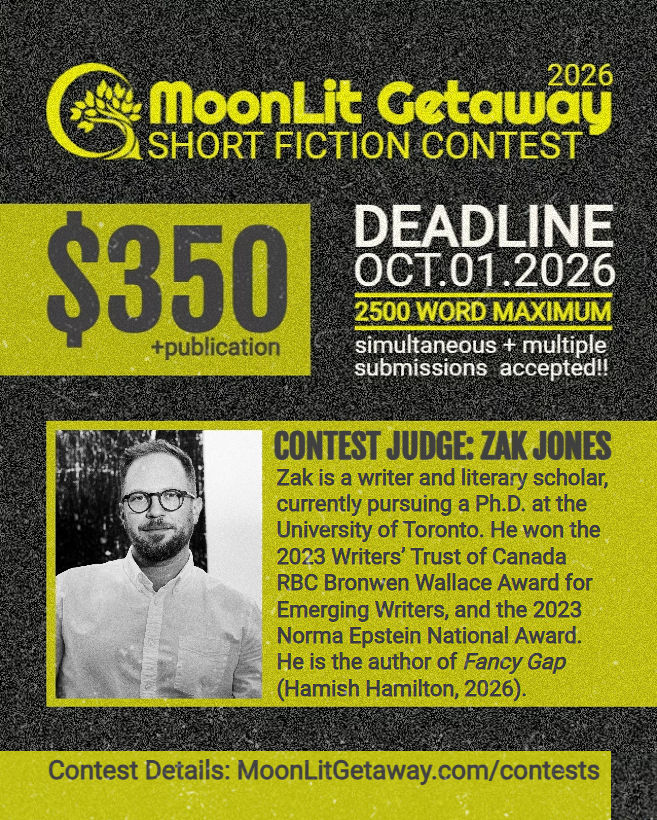
Author Interview: Zak Jones, 2026 Short Fiction Contest Judge

Zak Jones is the author of Fancy Gap (Hamish Hamilton, 2026). He is a writer and literary scholar. A dual Canadian-American citizen, he grew up between rural North Carolina and Toronto. Jones is currently a Ph.D. candidate at the University of Toronto studying veterans’ narratives in American Literature, writing his second novel, and developing an archival documentary project, Riding Six White Horses.
INTERVIEW
MG: Zak, we are thrilled to announce that you will judge our 2026 Short Fiction Contest. What will you be looking for in the stories you review? What makes for great short fiction?
ZJ: The most important thing about short fiction, to me, is the story. I appreciate beautiful prose, but without a solid narrative foundation I find it to be like ornamental wallpaper in a room with a sagging floor. I love experimentation in style and form, for sure, but I would really like to read a bunch of really strong stories.
MG: You won two short story awards in 2023: the Norma Epstein Foundation Award and the RBC Bronwen Wallace Award. How did it feel to win? Did anything change for you after receiving the awards?
ZJ: Winning a contest or a prize is a great feeling, but what it signalled to me was that I wasn’t crazy in thinking of myself as an artist. It is daunting to write and submit, write and submit, write and submit and come up with nothing but rejections and again and again. That is the life of an early career artist, absolutely, but eventually some kind of sign that you’re on the right track is necessary. Getting long or shortlisted for contests and awards goes a long way toward validating an artist’s belief in one’s art. Winning the Bronwen Wallace Award gave me enough momentum and confidence to try to publish my first novel. The money didn’t hurt either, but it was gone as quick as it came.
MG: Your debut novel, Fancy Gap, was released in February 2026. It is a gripping, evocative story about an Appalachian family afflicted by poverty, illness, and violence. As critics and readers review the book, have you been surprised by how they interpret aspects such as the plot, themes, or characters?
ZJ: I’m at once surprised and not surprised. We live in a pretty harrowing world and so it seems like many readers were disappointed that there isn’t a fairytale ending to the book or that the characters were “unlikeable.” This was new criteria to me. But I get it! Sometimes we read to escape the quotidian nightmare. But the world of Fancy Gap was just never so far away for me. It remains very real, and perhaps more real than when I started writing it.
The novel was listed in some corners as “dystopian fiction” so maybe that had something to do with readers’ hopes of a redemption arc. Maybe it is a genre thing. Unfortunately Fancy Gap isn’t in the realm of fantasy whatsoever; utopian, dystopian or otherwise. It is a tragedy in the classical sense. I was looking to portray a world and its characters that, like Shakespeare’s Denmark and Prince Hamlet, are inadequate to the monumental task ahead of them; the seemingly impossible task of existing into a brighter future while contending with the almost-unreal, unbearableness of the present. But I hear you! You hopeful, optimistic readers! My next novel follows a really wonderful and loveable protagonist, I think.
MG: You are a Ph.D. candidate at the University of Toronto studying veterans’ narratives in American Literature. What drew you to that topic? Which veteran writers interest you the most, and why?
ZJ: It dawned on me how much American literature corresponded directly with the structures of feeling that followed each of the country’s wars and how veterans are deployed in narrative to synecdochize those structures of feeling, whatever they may be. Paranoia during the Cold War, shame and humiliation and masculinist overcompensation post-Vietnam. I thought a good way to understand the historical and literary landscape of the late 20th century through to the present would be to examine these veteran representations of larger, shared American psychosocial determinants and to ask what guides what. Do we, in our cultural memory of the era, recall the broad cultural mood of humiliation and shame post-Vietnam because of those contemporaneous literary and cultural narrative productions? Or were those feelings encoded into our cultural memory through the popular narratives at the time; via The Things They Carried and Taxi Driver and Rambo? Sorry to sound like an egghead but you asked.
My favourite veteran writer… hard to say. I think the best living veteran writer is Phil Klay. Hemingway wasn’t technically a veteran, but he saw more action and participated in more international conflicts than most US Army Generals ever could. He might be my favourite, now that I’ve so quickly collapsed the category.
My favourite book about a veteran is Libra by Don DeLillo which re-tells the story of Lee Harvey Oswald’s entry into the American imagination. Although DeLillo isn’t a veteran either, so many of his works are concerned with these post, intra, and interwar structures of feeling that inform our memories of the 20th century to today.
MG: Tell us about your documentary project, Riding Six White Horses.
ZJ: My friend and brilliant documentary filmmaker Kate Colenbrander and I are working on an archival documentary, finishing a project that my mama started filming in the early 1970s. The title of her film project was Trilogy, and it documented the lives and stories of herself, her mother and her grandmother; three generations of Appalachian women, their histories, their memories, their intertwining stories. Much of the 16mm film had been damaged in the past fifty years of storage, as my mom carted it with her from rural North Carolina, to New York City, to Portland, Oregon, to New Orleans, Louisiana, to Seattle, Washington, to Wilmington, North Carolina, to Toronto, back to rural North Carolina, to Juneau, Alaska, to North Adams, Massachusetts, to Niceville, Florida, to Meadows of Dan, Virginia; all over the continent over fifty years. The film travelled with her throughout her life, then, when she died, she asked me to “finish” it and I promised I would. I brought it back here to Toronto.
Kate and I salvaged and scanned as much as we could, and the scans capture the deterioration and imperfection of the film; the time and weather having worked its magic on it, in some places almost to incomprehensibility. But my thought is that this what happens to memory, too. This is what happens to familial legacy and the memory of and about one’s elders and ancestors and all their trials and tribulations, all these details that come to create us in the present. So we decided not to utilize any digital retouching or AI correction software and to present the film in its re-edited, re-told state. We want it to be a testament to analog media and a testament to memory and to the staying power of art. It’s beautiful.
MG: What can you tell us about your writing process?
ZJ: I write sporadically and in manic bursts. I have file folders on my computer and dozens of notebooks filled with abandoned short stories, novels and poems. Could be any time of day or night, longhand or typed out on my computer, dictated into a voice note, whatever. What happens is that sometimes one of these won’t get out of my head, and I’ll have to go find where I started it, pull it out and transcribe it. If a story idea is any good, I think, I’ll remember it and finish it. Otherwise I’m always just trying-on new narratives out to see if they work.
Editing is more regimented. Once I have something real going, something with real momentum, I have to treat finishing it like a job or it won’t get done. Deadlines help.
MG: What is the best writing advice you’ve ever received?
ZJ: Try to find any mentions of “sort of,” “kind of,” “like,” “almost as if” etc. in your manuscript. Usually those phrases signal a hedging on the part of the writer, where you aren’t quite sure of your metaphor or where you don’t quite know where the sentence is headed. Not always! But it is a helpful reminder to be direct. Rather than “Her moods were sort of like sheet lightning in a grey sky,” it is better to say, “Her moods were sheet lightning in a grey sky.” I’m very guilty of cushioning my metaphors in this way. Finding and removing those hedging phrases helps me greatly.
MG: Where can our readers find you online?
ZJ: On Instagram @zakjones and on the web at www.zakjones.ca I have recent essays in The Toronto Review and The Globe and Mail. Poems all over the place.

Fancy Gap by Zak Jones
A powerful, unforgettable debut: three estranged generations in Appalachia grapple with loss, poverty, and their individual demons, until an explosive climax brings them together in apocalyptic deliverance.
2026 MoonLit Getaway Short Fiction Contest | DETAILS